

The UK Editor's Checklist: Ten Things to Check Before You Submit Your Manuscript
Most manuscripts are not rejected because the story fails. They are set aside because the first three pages are littered with small inconsistencies that make an editor's job harder than it needs to be. A misplaced comma will not sink a novel; a manuscript that contradicts itself on page two and page ninety might. The good news is that nearly all of this is fixable in an afternoon. What follows is the checklist worth working through before anything leaves your desk: spelling, punctuation, dialogue, formatting and the UK conventions that trip up experienced writers as often as beginners.
Choose a spelling system and stay loyal to it
British publishing expects British spelling. That means colour, favour, centre, metre, realise, organise, defence, licence as a noun and practise as a verb, grey, plough, travelled, cancelled, labelled and ageing. The -ise ending is the safer default in UK fiction, though Oxford style prefers -ize in some contexts. Whichever you choose, hold the line from the first page to the last.
Watch for Americanisms that slip in unnoticed: gotten, sidewalk, elevator, apartment, faucet, math, fall for autumn, cell phone, and the habit of writing toward where a UK reader expects towards. Both forms exist, but consistency matters more than the choice. Proper nouns and quoted material keep their own spelling, so a character from Chicago can say sidewalk without breaking your style.
Punctuation: the small marks carry weight
House style varies, so pick a system and apply it evenly.
- Commas. The serial comma is optional in UK style. If you use it before and in one list, use it in all of them.
- Dashes. An en dash (–) handles ranges: 1998–2003, pages 12–18. For an interruption in speech or thought, UK publishers often use a spaced en dash – like this – rather than the closed em dash common in US books.
- Ellipses. Either type the single character (…) or three full stops with spaces (. . .). Choose one and do not mix.
- Abbreviations. Modern British style drops the full stop from Mr, Mrs, Ms, Dr and St, and generally writes eg, ie and etc. without full stops or following commas.
- Titles. Italicise book, film and album titles. Put shorter works — poems, short stories, episodes, chapters — in quotation marks or italics, whichever you have chosen.
- Numbers. Spell out one to nine and use numerals from 10 upwards, unless you are writing dialogue or a character's thought. Keep measurements, dates and times in numerals.
Dialogue: get the mechanics right
In UK publishing, dialogue sits inside single quotation marks, with double marks for a quotation inside speech. Each new speaker starts a new paragraph, and punctuation stays inside the closing mark.
‘I’m not going,’ she said. The comma belongs inside, and she stays lowercase because the sentence continues.
‘Are you coming?’ he asked. No comma before a question mark.
‘Fine.’ She turned away. An action beat takes a full stop, not a comma, because the words are not being spoken by the action.
Use a dash for an interruption — ‘I was going to—’ — and an ellipsis for a voice trailing off. Keep your tags plain: said and asked do their job and disappear. Any writer who has a character opine, retort or chuckle halfway through a tense exchange has reminded the reader that someone is typing. Also check that each line of dialogue belongs to the right speaker, especially in long scenes where two characters talk without tags.
Formatting that lets the writing breathe
Presentation will not sell a weak book, but poor presentation will distract from a strong one. Editors read hundreds of manuscripts, and a clean file is a small courtesy.
- One serif font, 12 point, black, throughout. No coloured text.
- Double-space the body text and leave 2.5cm margins. Align left; do not justify.
- Indent the first line of each paragraph by about 0.5cm, except the opening paragraph of a chapter and the first paragraph after a scene break.
- Mark scene breaks consistently with a blank line and a centred symbol such as # or * * *.
- Number your pages, and put your surname and the book title in the header.
- Start with a title page: title, rounded word count, genre, your name and contact details.
- Use one space after a full stop, not two. Never use tabs or manual line breaks to push text around.
- Use italics for emphasis and internal thought; avoid block capitals for shouting.
Consistency is a kindness to your reader
Keep a style sheet as you write. Note how each name is spelled, which job titles are capitalised, how invented words are punctuated, and when each event happens. Then use the search function ruthlessly. Is the family dog a spaniel in chapter two and a Labrador in chapter nineteen? Was the wedding in June or July? Does the village have a church in one scene and no church at all in the next? A reader will forgive almost anything except being confused by a world that keeps shifting under their feet.
The final read — away from the screen
Print the manuscript, or change the typeface to something unfamiliar, and read it aloud. Your ear catches what your eye skips. Read the first chapter and the last chapter with extra care, because those are the pages a reader will remember most clearly. Then run a targeted search for the slips that spellcheck misses: its and it's, their and there, lead and led, practice and practise, effect and affect, compliment and complement, discreet and discrete. Reading paragraph by paragraph in reverse order is a surprisingly effective way to find typos, because it stops your brain from predicting what comes next.
Before you press send
Read the submission guidelines and follow them exactly. Send the file type, page count and chapters that were requested, and nothing more. Label the file with your name and the book title. Proofread your covering email with the same attention you gave the manuscript, then close the document and stop fiddling. A manuscript you have checked ten times is not improved by a fifteenth pass; it is only delayed. The work is done — let it go out looking as good as it truly is.
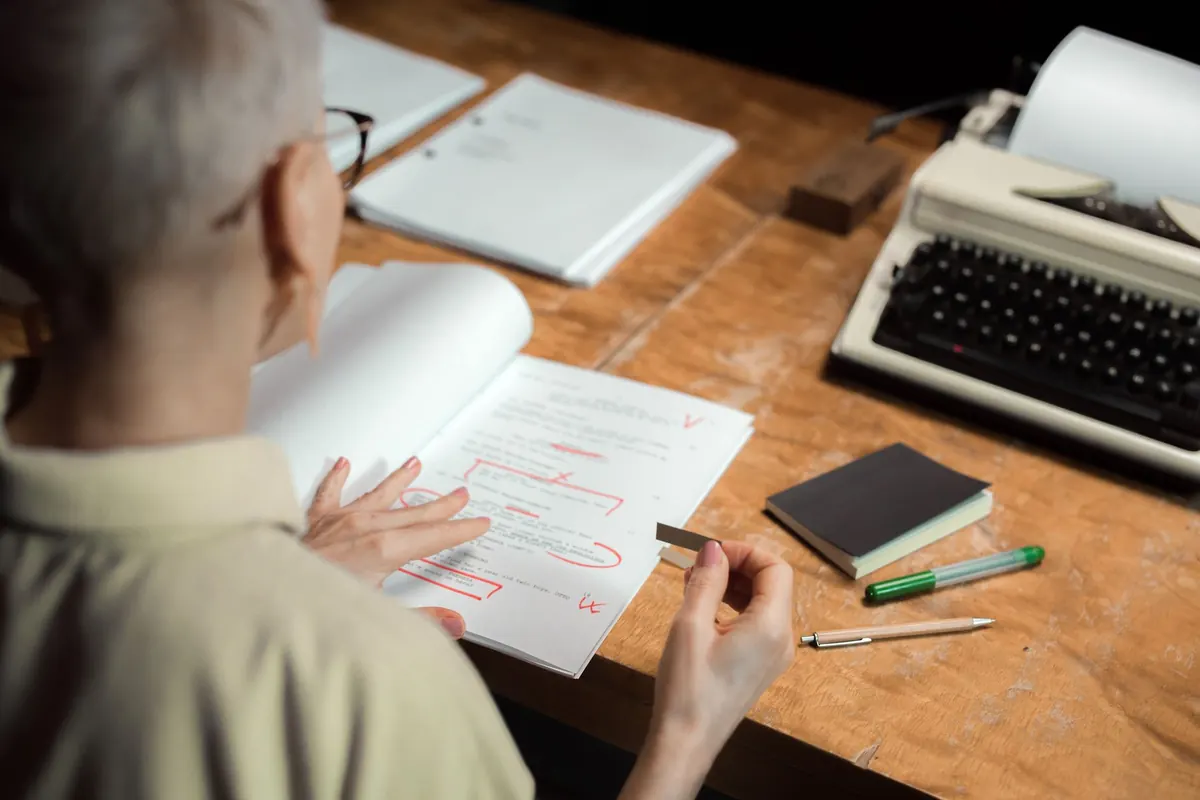
Photo: Ron Lach / Pexels